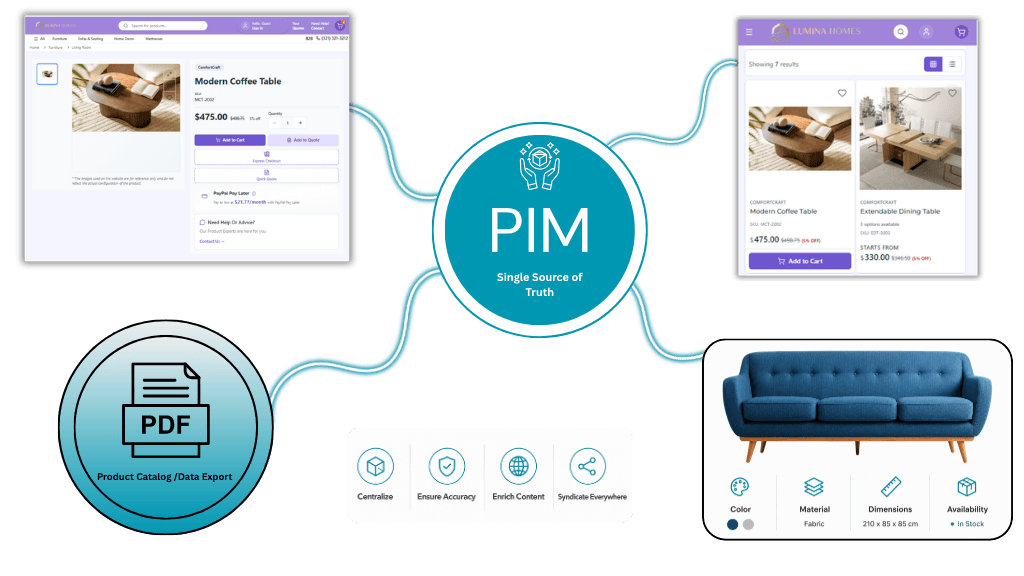
TDCCommerce Product Information Management keeps all product data organized on a single unified platform, enabling faster updates, more accurate catalogs, and easier management across all sales channels.
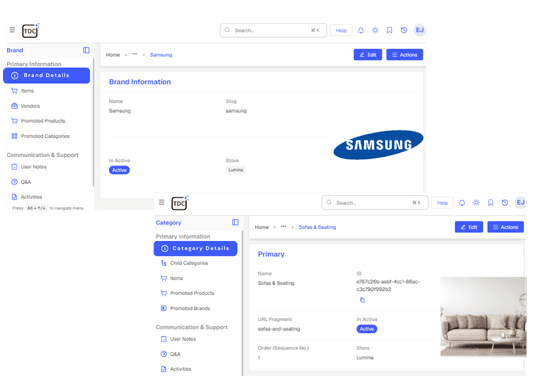
Manage brand information and organize products into clear category structures across systems. This helps maintain consistent branding, improve product organization, support accurate reporting, and create a smoother browsing experience for customers.
Create multiple product catalogs for different markets, regions, or sales channels. Organize products with flexible catalog structures and launch targeted offerings faster.
.png&w=3840&q=75)
Stores images, videos, manuals, and marketing files directly with product records, ensuring teams always use the latest approved materials. Assets are easy to find and reuse across channels, helping prevent duplication and outdated visuals while maintaining consistent, professional product listings.
-1.png&w=3840&q=75)
Manage descriptions, prices, SKUs, and product details from one place. Maintain accurate, consistent, and easy-to-update product information across all channels.
.png&w=3840&q=75)
Automatically fills missing product information using trusted data sources
Generates complete product listings from PDF uploads and website links to reduce manual entry
Uses category-specific AI instructions to create more accurate and relevant product content
Maintains consistent and up-to-date catalog information across products and sales channels
Manually inputting product attributes, specifications, and pricing increases the risk of human error and slows down time-to-market. Automation eliminates repetitive data entry, reducing errors and accelerating product launches.
Handling extensive catalogs with deep hierarchies, multiple attributes (like size, color, or material), and diverse sales channels quickly becomes overwhelming. Structured configuration simplifies catalog management, making it easier to organize, scale, and update complex product relationships.
Incomplete product details, unoptimized SEO, and inconsistent formatting across different storefronts harm discoverability and the buyer experience. Maintaining rich, optimized, and uniform product content ensures a seamless, high-quality presentation across all sales channels.
%2520(1)%2520(3).png&w=3840&q=75)